AI, agency, and community: Buffalo State hosts cross-sector conference on the future of learning and work

On April 17, SUNY Buffalo State University hosted the “AI & Agency: Reshaping Learning and Work” conference, bringing together participants from across higher education, K–12, industry, and the public sector for a day focused on the evolving role of artificial intelligence in society. The event reached capacity, with approximately 100 participants in attendance, reflecting strong interest in cross-sector engagement around artificial intelligence (AI).
In E.H. Butler Library, faculty, administrators, students, business leaders, and community partners engaged in shared conversations about how AI is shaping teaching, learning, and the future of work. The conference was supported by a BSU GAC grant in partnership with local academic institutions, industry, Buffalo Niagara Medical Campus and Erie County, reflecting a shared commitment to bringing together diverse groups across the region to engage with the opportunities and challenges of artificial intelligence.
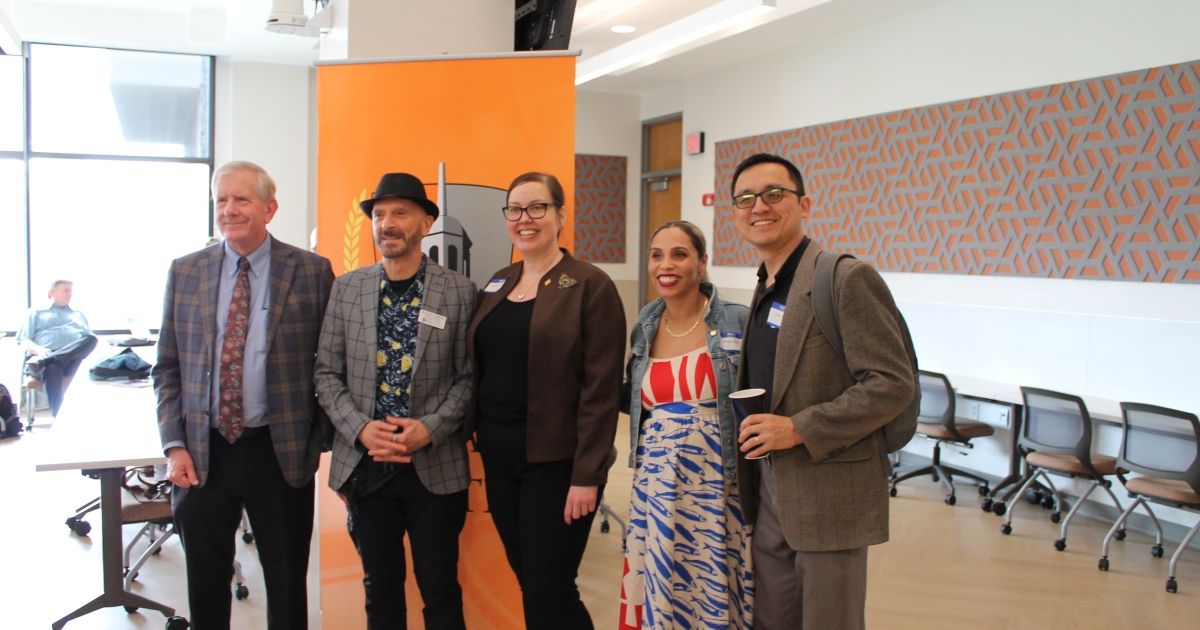
The conference organizers extend their appreciation to Amitra Wall, Buffalo State provost and vice president for academic affairs, and Kevin Hardwick, Erie County comptroller, who delivered welcoming remarks and expressed support for the next generation of educators and scholars working to engage with AI in thoughtful, safe, and ethical ways.
A cross-sector conversation
The conference brought together participants from multiple institutions and organizations, creating space for dialogue across roles that are often siloed. Representatives from higher education, local school systems, industry, and government contributed to discussions that moved beyond individual classrooms to consider broader systems and structures.
This mix of perspectives reinforced a central theme of the event: AI is not confined to a single discipline or sector. Its impact spans education, workforce development, public administration, and community engagement. By bringing these voices together, the conference created an environment where participants could examine shared challenges and explore coordinated responses.
Keynote spotlight: Trust and integrity in the age of AI
A keynote highlight of the conference was delivered by Siwei Lyu, a leading expert in artificial intelligence and digital media forensics. Lyu is Director of the Institute for Artificial Intelligence and Data Science and co-director of the Center for Information Integrity, where he leads interdisciplinary efforts focused on misinformation and digital trust.
His research on deepfakes and synthetic media has been widely recognized for advancing methods to detect AI-generated images and videos. In his speech, Lyu emphasized that as these technologies become more realistic and accessible, the challenge extends beyond technical detection to broader concerns about information integrity and public trust. He also noted that AI has significantly shortened the time and reduced the number of steps required to acquire computing skills, making powerful technical capabilities available to a much broader population. This growing accessibility, he suggested, brings both new opportunities and greater responsibility in how such tools are used.
His remarks reinforced a central theme of the conference: that the future of AI depends not only on innovation, but on responsible development, critical evaluation, and cross-sector collaboration.
Panels and sessions
The conference featured a series of panels and interactive sessions that explored AI from multiple angles, including teaching and learning, workforce implications, and ethical considerations.
Participants and presenters represented a range of institutions, including SUNY Buffalo State University, the University at Buffalo, SUNY Erie Community College, Canisius University, and Niagara University, along with partners from Erie County, regional industry, and the design and technology sectors, including representation from Institute for Grounded Research and Integrated Development (INGRID), Forrester, CCNY, and ParakeetAI. This mix of higher education, public sector, and industry perspectives contributed to a more comprehensive discussion of AI across educational and professional contexts.
Sessions examined how AI is being used in classroom and workplace settings, highlighting both opportunities and challenges related to student learning, skill development, and decision-making. Discussions also addressed practical applications of AI tools, as well as broader questions of equity, access, information integrity, and responsible use.
Across sessions, a consistent idea emerged: as AI becomes embedded in everyday practice, educators and organizations are increasingly called to reconsider how learning is structured, how work is produced, and how understanding is demonstrated. Several sessions also explored how AI is prompting educators to reconsider how assignments are designed and how student learning is evaluated in AI-enabled environments, reflecting a growing shift toward more intentional, design-centered approaches to teaching.
“Buffalo State is building on sustained momentum in AI engagement. This conference reflects our ongoing commitment to regional collaboration that supports student learning and academic excellence.”
Institutional leadership and support
The conference was also shaped by the leadership and support of Amitra Wall. Her support of initiatives that explore the intersection of AI, teaching, and learning reflects the institution’s broader commitment to student learning and academic excellence, as well as to thoughtful, faculty-centered innovation.
“Buffalo State is building on sustained momentum in AI engagement,” Wall said. “This conference extends that work and reflects our ongoing commitment to practical, faculty-centered innovation and regional collaboration that supports student learning and academic excellence.”
By fostering spaces for dialogue and collaboration, institutional leadership plays a critical role in advancing work that addresses both the opportunities and challenges of AI in higher education.
Conference leadership and organization
The conference was organized through a collaborative effort led by Buffalo State faculty members Joaquin Carbonara, Angela Thering, and Naila Ansari Catilo, whose collective expertise spans data science, education, community engagement, and AI-enabled teaching and learning.
The event was supported by Ginson Street, the Buffalo Niagara Medical Center CIO (Sam Marrazzo) and the Graduate Advisory Council (GAC) at Buffalo State, reflecting institutional and community investment in advancing conversations around AI, education, and the future of work.
Together, they designed the conference as a cross-sector convening that intentionally brought together voices from higher education, K–12, industry, and the public sector. This approach reflects a recognition that the challenges and opportunities associated with AI cannot be addressed within a single domain, but require coordinated, interdisciplinary collaboration.
The organizers emphasized both practical application and critical inquiry, creating a program that balanced hands-on exploration with deeper conversations about pedagogy, workforce implications, and information integrity. Their work positions Buffalo State as a space for ongoing dialogue and innovation at the intersection of AI, education, and community impact.
Building on a growing AI initiative
This conference builds on Buffalo State’s earlier work to engage the campus and broader community in conversations about artificial intelligence. In 2025, the university hosted a high-demand workshop on augmented human intelligence that brought together students, faculty, and community members for hands-on exploration of AI tools and applications. The event reached capacity and reflected strong interest in understanding how AI can enhance human capabilities and support learning.
The “AI & Agency” conference represents a natural progression of this work. While earlier programming focused on building familiarity with AI tools and practices, this event expands the conversation to address broader questions of teaching, learning, public trust, and workforce impact. By bringing together participants from different sectors, Buffalo State continues to evolve its role as a hub for collaborative, cross-sector engagement with AI.
Looking ahead
As AI continues to evolve, so too must the structures that support learning. The conference’s conversations suggest that the most pressing questions are no longer about whether AI will be used, but how educators, institutions, and communities can respond in ways that support meaningful engagement, critical thinking, and trust.
In this context, collaboration across sectors will be essential. By convening diverse perspectives and grounding discussions in real-world practice, Buffalo State is helping to shape how AI is understood and integrated at a moment of significant change.