Buffalo State’s Women in Technology program supports and empowers

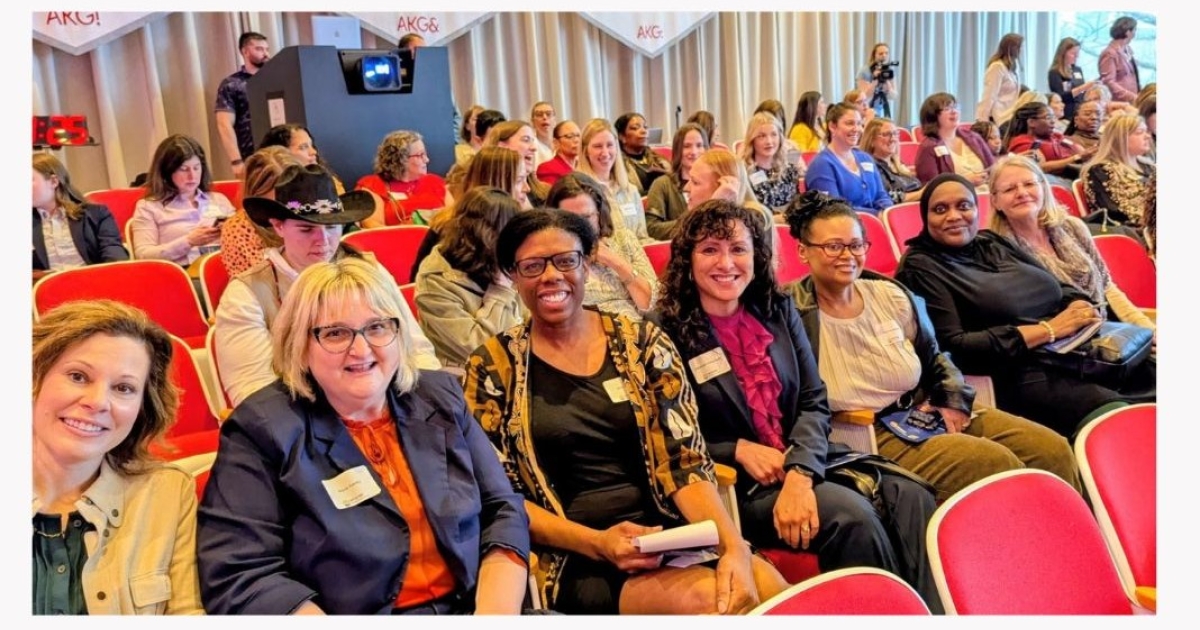
In late February, Buffalo State University, in partnership with Institutional Equity, Diversity, and Inclusion and Academic Affairs, launched the Buffalo State Women in Technology program as a faculty and staff initiative operating under the SUNY Women in Technology (WIT) program. The university’s recent International Women’s Day event reflected its commitment to empowering women across disciplines, and WIT furthers this mission by supporting faculty and staff in developing their expertise, sharing knowledge, and inspiring the next generation pursuing careers in technology.
“The creation of WIT at Buffalo State provides a wonderful opportunity for the campus to come together to highlight and celebrate gender diversity in technology,” said Lisa Morrison‑Fronckowiak, chief diversity officer. At Morrison-Fronckowiak’s invitation, WIT participants attended the Women United International Women’s Day Discussion, which brought together community leaders to discuss empowering women.
“In a world increasingly shaped by technology, initiatives like Buffalo State’s chapter of Women in Technology help ensure that technological literacy and opportunity remain accessible to all faculty and staff across our academic community,” added Amitra Wall, provost and vice president for Academic Affairs.
Technology at Buffalo State is not confined to a single department; it lives in classrooms, advising centers, research labs, offices, healthcare spaces, libraries, and outreach programs where it strengthens learning, enhances collaboration, improves processes, and expands opportunity. As such, Buffalo State WIT is not limited to formal IT roles; it is for educators transforming learning with digital tools, advisors leveraging systems to support students, administrators improving workflows, researchers exploring emerging technologies, and professionals across campus who rely on innovation to move the institution forward.
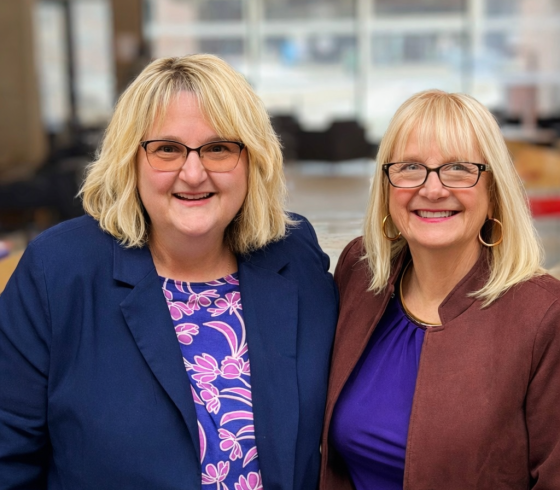
Maria Garrity (left) and Sue McCartney
Buffalo State WIT leadership includes Morrison-Fronckowiak and Wall as executive advisors and co-chairs Maria Garrity, senior programmer/analyst for Information Technology and Susan McCartney, director of the Small Business Development Center. (More information about the WIT advisory team is available in the Daily Bulletin.)
The launch of WIT is a full-circle professional moment for Garrity and McCartney, as Garrity began her career as intern at the Greater Buffalo Small Business Development Center more than 40 years ago, where she worked alongside McCartney.
“Sue has been a mentor to me for years as a successful woman in business,” Garrity said. “The launch of WIT creates new opportunities for faculty and staff to collaborate, share knowledge, and support women pursuing careers in technology while strengthening Buffalo State’s commitment to innovation and student success.”
As we celebrate Women’s History Month, Buffalo State and WIT recognizes and honors the achievements of women in technology across campus. When asked to highlight the many ways faculty and staff integrate technology into their work every day, WIT participants cited the following examples:
- Wendy Paterson, professor and interim dean of the School of Education and Applied Professions, reflected on the rapid evolution of educational technology and the responsibility of educators to help students use technology thoughtfully and creatively.
- The Small Business Development Center’s all-female team of business advisors participates in ongoing professional development and explores emerging tools such as artificial intelligence to better support entrepreneurs.
- Professor Sarbani Banerjee, along with associate professor and computer information systems (CIS) internship coordinator Ramona Santa Maria and former CIS Department chair Neal Mazur, co-founded the Women in Computing Club to support students in CIS and Engineering Technology. Through this initiative, students organized coding and cybersecurity workshops, participated in hackathons, and volunteered at Girls Coding Camps and Girl Scout coding events. Banerjee also mentors Buffalo State youth and students in the Faculty Engaged Series. Santa Maria also guides young women in CIS, helping them build the confidence and capability to excel in tech careers. Mazur noted that initiatives like GenCyber Camp help middle and high school teachers introduce cybersecurity concepts to their students.
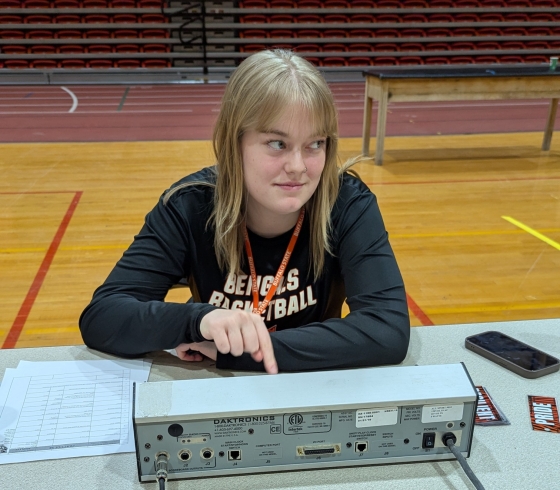
Assistant coach Brooke Woodard uses technology to support the women's basketball team.
- Lecturer Diane Dillon, a retired vice president of information technology at Ingram Micro, brings global industry experience to the classroom. After leading technical teams across five continents for a Fortune 100 company, she now helps Buffalo State students with careers in IT through collaboration and real-world problem solving.
- Andrew Garrity, CIS lecturer, works with educators on topics such as cyber ethics and online safety, helping teachers prepare students to recognize phishing scams, protect data, and navigate cyber threats responsibly.
- Valerie Celenza cited the Ron Brown Scholarship, which supports Buffalo State students who demonstrate meaningful use of technology in their studies and future careers.
- The Career and Professional Education Center (CAPE) provides career counseling, employer partnerships, internships, and professional development opportunities to help students translate their skills into meaningful careers. CAPE works to ensure that women pursuing technology-related and educational careers have access to opportunities that support leadership and innovation.
- Clinical manager April Petrik mentioned that the Weigel Health Center’s electronic medical record system supports scheduling, documentation, and collaboration among staff. The center’s all-female team works together to continually improve the system to better serve students.
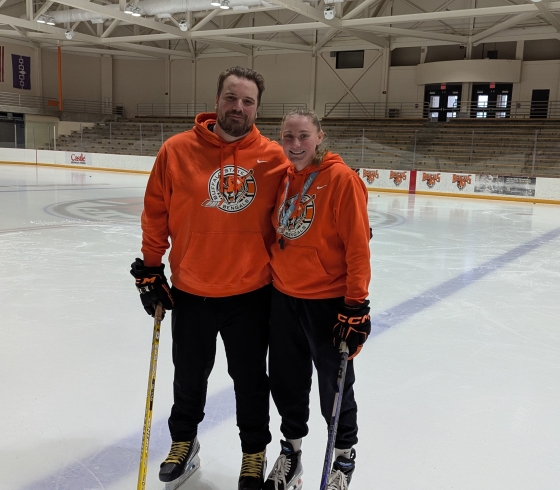
Christian Foerstner and Rachel Grampp
- Women’s basketball coach Scott Foster and assistant coach Brooke Woodard use digital platforms such as HUDL, Synergy Sports, and FastScout to analyze performance and prepare for games. Women’s ice hockey coach Rachel Grampp and assistant coach Christian Foerstner use video analysis tools to review practices and games, helping players improve performance and prepare strategically for opponents.
- Elizabeth Grady, director of development events, began her career in the late 1990s working with theatrical lighting technology. She now blends creativity and technology by using data and digital tools to plan fundraising events that support student scholarships.
- Erin Habes, lecturer for fashion textile technology said, “As apparel production moved overseas, the fashion industry became increasingly technology driven. Buffalo State’s fashion and textile technology program equips students with digital design, 3D visualization, tech packs, and PLM tools for the global fashion industry.”
- Women contribute significantly to Buffalo State’s online programs and microcredentials. Program coordinator Andrea B. Nikischer said, “We honor women who use technology by centering their expertise in the creation of Buffalo State’s online programs and microcredentials, allowing them to scale their impact and teach the next generation of educators how to combine pedagogy and technology.” Vicky Lee, a graduate of the Adult Education M.S. program who earned microcredentials in Instructional Design and Online Teaching and received the Adult Education Comprehensive Exam Award, is now pursuing a Ph.D. in Education at George Washington University with a fully funded research assistantship focused on human-technology collaboration in higher education.
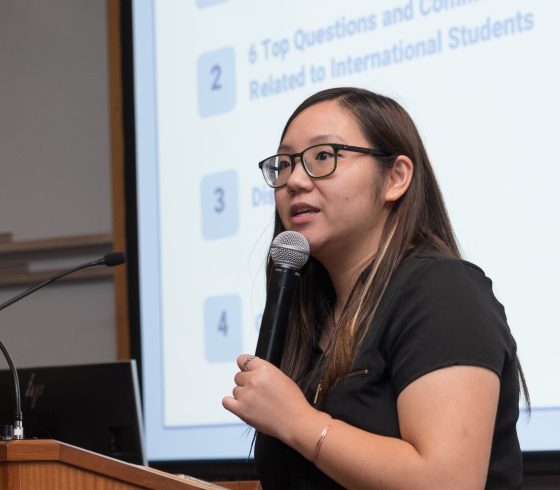
Vicky Lee
- Angela Thering, lecturer in the adult education program, said students learn from observing how faculty use technology responsibly and creatively.
- Kristy Mediak, director of procurement and strategic sourcing said, “In 2023, I led the campus-wide rollout of our e-procurement system, Bengal Buy, reducing processing time from four weeks to just three days. We are now preparing for Phase 2 with the implementation of Total Contract Manager, which will create a fully digital contract workflow and improve visibility, compliance, and efficiency.”
These examples, ranging from academic programs and student mentorship to operational innovation and athletics, demonstrate how Buffalo State fosters an environment where women can lead, innovate, and thrive across many areas of technology and education.
Faculty and staff interested in participating in the Buffalo State WIT community and sharing ideas for future programs and events are encouraged to connect with the WIT leadership team. To be added to the Buffalo State WIT email distribution list, please contact Maria or Sue. The WIT team looks forward to welcoming new participants and sharing details about upcoming campus events.
The SUNY WIT Program is open to any and all eligible employees as defined by SUNY regardless of race, color, national origin, sex, or any other protected class and is consistent with all current governing federal and state non-discrimination law.
Photos by Maria Garrity; photo of Garrity and McCartney by Small Business Development Center.